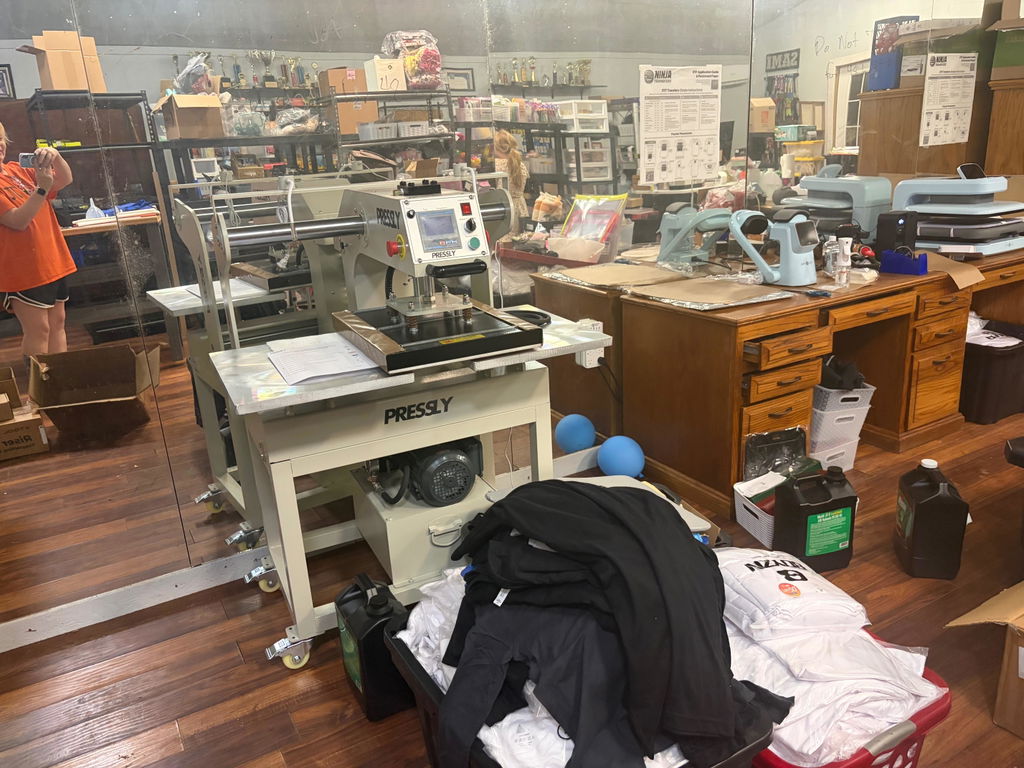
A Cricut heat press can remain useful long after a small apparel business begins selling products. Growth alone does not mean the machine must immediately be replaced. The more useful question is whether the current press still supports the jobs, batch structure, working area, and production pace the business now requires.
That question became more nuanced in 2026 because Cricut introduced AutoPress 2 with a 15-by-15-inch heat plate and positioned it for larger projects and batch making. A growing business therefore should not treat “Cricut” and “commercial production” as automatic opposites.
The upgrade decision should be based on a verified operational limitation.
When Should You Upgrade?
Consider evaluating a larger commercial press when your current machine repeatedly limits working area, batch workflow, operator efficiency, serviceability, or the production configuration required by your approved jobs.
Do not upgrade simply because order volume increased. Upgrade when you can identify what the current equipment prevents the business from doing efficiently or consistently.
Start With the Exact Cricut Model
Before declaring that a Cricut press is too small or too limited, identify the exact model.
Cricut's current AutoPress 2 documentation specifies a 15-by-15-inch heat plate. The company also describes the model as suitable for larger projects and batch making.
That means advice based on an older handheld EasyPress or the original Autopress should not automatically be applied to AutoPress 2.
Write down the current model, heat-plate dimensions, supported workflow, and the specific limitation your shop is experiencing. That becomes the baseline for an upgrade comparison.
Signal One: Your Jobs Exceed the Working Area
Working area is one of the easiest upgrade triggers to verify.
If approved designs regularly exceed the usable area of the current press and the transfer method requires a single application, a larger platen may solve a real production problem.
Do not assume every oversized design can simply be pressed in sections. Application methods have different requirements, and the transfer manufacturer's instructions should determine whether sectional pressing is acceptable.
A shop that increasingly produces large back graphics, workwear, oversized apparel, or other applications requiring more working space may reasonably evaluate a commercial 16-by-20-inch format.
The decision is not “bigger is better.” It is “the existing working area no longer accommodates the work we have already chosen to produce.”
Signal Two: Batch Handling Becomes the Bottleneck
Cricut markets AutoPress 2 for making in batches and multiples. That is an important reminder that batch work alone does not prove a commercial machine is necessary.
Instead, observe the batch.
Does the operator consistently wait for the machine? Does garment loading create congestion? Does the next piece remain unprepared until the active cycle ends? Does the workstation force unnecessary movement between every garment?
If the issue is surrounding workflow, a better layout may help without replacing the press.
If the equipment's physical configuration prevents the operator from preparing work while the current garment is being pressed, another machine layout may provide an operational advantage.
Signal Three: Production Depends on One Press
A growing business may reach a point where one machine is no longer just a crafting tool. It becomes a production dependency.
At that stage, serviceability matters more.
Ask how the machine is supported when production stops. Can the business identify the correct replacement components? Is technical support available? Is the equipment intended to be serviced through a documented support path?
A commercial equipment decision should therefore include more than maximum temperature or platen size. Parts access, service documentation, installation requirements, and support become operational considerations.
DTF Bank maintains a dedicated heat press parts collection for supported equipment. Parts availability does not eliminate downtime, but it gives production managers another factor to compare before equipment becomes critical infrastructure.
Signal Four: Manual Work Dominates the Shift
Operator effort should be evaluated through repeated production rather than one demonstration.
If a machine requires the operator to repeat a demanding physical action throughout long batches, the business can compare alternative mechanisms that change that specific task.
Do not reduce this decision to an “automatic versus manual” label. Ask which movement is being assisted, which actions remain manual, and whether the difference addresses the actual production constraint.
The goal is not to remove the operator. It is to reduce unnecessary repetitive work while maintaining the approved transfer process.
Five Questions Before Upgrading
1. What No Longer Fits?
Identify the real applications that exceed the current equipment's working area.
2. Where Does Time Disappear?
Measure loading, alignment, pressing, unloading, and job transitions rather than relying on dwell time.
3. What Happens During Failure?
Determine whether one unavailable machine would stop customer production.
4. What Requires Repeated Effort?
Observe operator movements across a normal batch instead of one cycle.
5. What Will the New Press Solve?
Require a specific answer before comparing purchase prices or features.
Do Not Upgrade for the Wrong Reason
A commercial press does not automatically improve every transfer. The transfer, substrate, time, temperature, pressure, and application procedure still have to be compatible.
Likewise, a larger machine does not guarantee more completed shirts per hour. Production output depends on the entire operating sequence.
Another weak reason is feature accumulation. More controls, greater pressure capability, or additional work positions only create value when those features solve a requirement in the shop's workflow.
Start with the constraint. Then evaluate equipment.
Compare the New Production Environment
Moving from a tabletop press to commercial equipment can change the installation itself.
A larger machine may require more floor space, a dedicated support structure, different electrical service, additional shipping and handling planning, or a more formal maintenance routine.
DTF Bank's HYDRO1620, for example, is a large hydraulic moving-head system with a 16-by-20-inch class platen and specific installation requirements. Its product documentation should be reviewed as a complete equipment configuration rather than as a simple size upgrade.
The business should be ready for the new machine's environment before treating increased capacity as usable capacity.
Build an Upgrade Case From Real Orders
Review recent production instead of forecasting from ambition alone.
Which jobs were difficult because of platen size? Which batches repeatedly created waiting? Which orders required workarounds? How much production depends on one machine? Which limitation appears repeatedly rather than once?
A simple job log can reveal whether the same problem recurs.
Repeated evidence is stronger than saying the business is getting busier.
If the records show that the current press handles the actual work comfortably, an immediate upgrade may not be necessary. If they show the same verified constraint across multiple orders, equipment evaluation becomes easier to justify.
Upgrade to Remove a Constraint
The right time to move beyond a Cricut press is not defined by a universal monthly order count. It is the point where the current machine repeatedly fails to support a requirement the business actually has.
When that constraint is clear, use DTF Bank's high production heat press guide to compare larger production-oriented configurations against the problem you need to solve.
Frequently Asked Questions
Can a Cricut press handle business orders?
Potentially, depending on the model, application, batch structure, and business requirements. Cricut currently positions AutoPress 2 for larger projects and batch making.
Is 15 by 15 enough for production?
That depends on the dimensions of the approved applications. Working area should be compared with actual job requirements rather than a universal minimum.
Should I upgrade when orders increase?
Not automatically. Identify whether the press is the limiting part of the workflow before purchasing larger equipment.
Is a 16-by-20 press always better?
No. A larger platen solves an area limitation. Other production problems may involve workflow, serviceability, operator handling, or job structure.
What should I compare besides size?
Compare installation requirements, machine layout, pressure system, operator workflow, support, maintenance needs, and how the equipment addresses your verified production constraint.