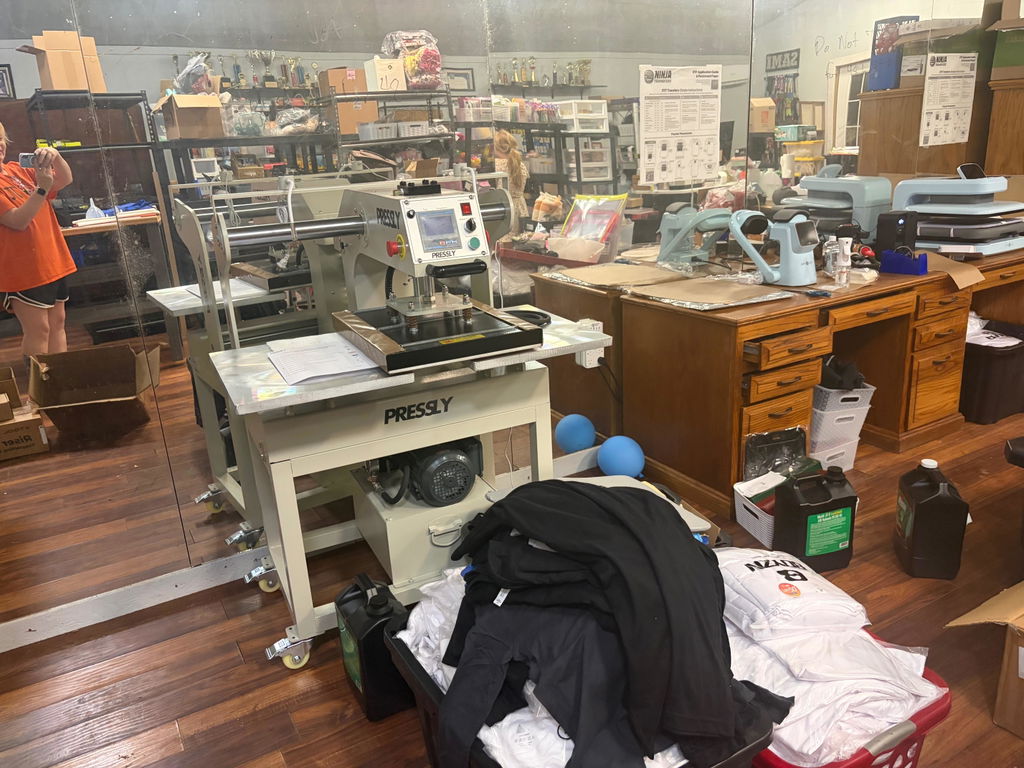
The biggest heat press is not necessarily the machine a growing apparel shop needs. A large flat pressing area, a wide heated cylinder, and several garment stations describe different capabilities. Comparing them through one maximum-size question can lead to buying equipment for the wrong production process.
A better starting point is to identify what enters the machine: a finished garment, an individual textile panel, or continuously fed fabric. That distinction explains why large-format flatbed presses and rotary systems should be compared by application architecture before dimensions or advertised speed.
What Is the Difference Between Flatbed and Rotary?
A flatbed press brings an individual load into contact with a heated pressing surface for a defined cycle. A rotary textile transfer system moves suitable material through a heated contact path. Some rotary systems support cut pieces as well as continuous fabric, so model-specific capabilities matter.
Why There Is No Useful Single Biggest Answer
Size can mean platen width, platen length, cylinder working width, machine footprint, or the dimensions of the material being processed. Those measurements describe different things.
A wide rotary machine does not provide a flat working rectangle in the same way as a platen press. A large flatbed does not automatically handle material continuously. A two-station apparel press does not become a wider press simply because it has two lower work areas.
Before comparing specifications, state the dimension that constrains the intended application. This turns a vague search for the biggest machine into a more useful question about the required working format.
Flatbeds Process Discrete Loads
A flatbed arrangement provides a working surface on which an individual application is prepared. The machine completes its pressing cycle, releases, and receives the next prepared load.
This architecture can suit separate garments or panels when the machine and transfer system are compatible. The important feature is the repeated placement of individual items rather than continuous movement through a heated path.
As working dimensions increase, handling still needs attention. A large area must be loaded, positioned, and unloaded practically. The existence of extra platen space does not explain how those actions will be completed or how much useful output the operator will produce.
Rotary Systems Use a Moving Contact Path
Rotary heat-transfer equipment is commonly associated with textile sublimation workflows. Instead of closing a flat upper platen over each garment, the system guides appropriate material through contact with a heated cylinder.
Monti Antonio's T10 technical description identifies sublimation printing on continuous fabrics and precut pieces. That documented example matters because rotary should not be simplified to rolls only.
However, the ability to feed precut material does not mean every finished T-shirt, every transfer chemistry, or every garment construction is compatible. The manufacturer must identify the permitted applications and feeding method for the actual system.
Compare the Work, Not Just the Width
| Question | Flatbed evaluation | Rotary evaluation |
|---|---|---|
| What enters the machine? | An individually prepared load | Compatible continuous material or supported pieces |
| How is contact organized? | A closed pressing cycle | Movement through a heated contact path |
| What dimensions matter? | Usable pressing area and application geometry | Working width and documented feeding capability |
| What requires confirmation? | Load access, transfer requirements, and cycle operation | Material handling, transfer process, and system configuration |
This comparison identifies different architectures, not a winner. A machine can be highly capable within its intended process and still be inappropriate for another shop's products.
Larger Does Not Automatically Mean Higher Production
Working area and production capacity are separate specifications. A useful real example appears in Geo Knight's MAXI-PRESS documentation: the manufacturer describes a large-format manual press while identifying its intended use as light, low-volume work.
That example prevents a common assumption. Large dimensions can solve an application-size problem without solving a repeated-output problem.
When production volume is the goal, investigate the complete operating arrangement: loading effort, assisted movement, staffing, and the sequence required between applications. Do not calculate expected output from working area alone or present a machine's largest supported item as evidence of continuous production performance.
Separate Garment Decoration From Fabric Production
A shop decorating purchased T-shirts has a different production input from a business transferring artwork onto fabric before cutting and sewing. Both may describe their output as printed apparel, but the heat-transfer stage occurs at a different point.
Consider two hypothetical businesses. One positions individual chest graphics on finished shirts. The other handles printed textile panels intended for later assembly. Their products may eventually look similar, yet their loading and handling requirements are not equivalent.
This is why a rotary sublimation system should not be described as a larger replacement for any garment heat press. Establish process compatibility first. Only then compare size within equipment that can perform the required task.
Two Stations Solve a Different Question
Multiple work positions concern preparation and machine utilization, not necessarily application width. They can provide separate places for preparing loads while sharing parts of the pressing system.
DTF Bank's HYDRO1620 head-moving heat press illustrates an apparel configuration with two lower working areas. That configuration belongs in a garment-application discussion rather than being confused with continuous textile processing.
Ask whether the constraint is the dimensions of one application, the way material enters the machine, or the time between individual cycles. These are different reasons for changing equipment, and they should not be collapsed into one request for a bigger press.
Request a Demonstration of the Intended Process
A relevant demonstration should show the type of input your operation will use. Watching a machine handle a different material format can demonstrate motion without proving application suitability.
For flatbed work, request an explanation of how a complete load is prepared and removed. For rotary work, ask how the intended fabric or cut pieces enter, travel through, and leave the system. Confirm which adjustments are operator responsibilities and which require technical setup.
Have the supplier identify the supported transfer process and installation requirements in writing. Do not replace those requirements with assumptions drawn from a similar-looking machine or an unrelated production video.
Transfer Chemistry Still Controls Compatibility
Machine architecture does not erase the differences between decoration methods. Equipment documented for sublimation should not automatically be assumed to apply adhesive-based garment transfers, even if both processes involve heat.
Similarly, choosing a flatbed layout does not establish a universal application recipe. The transfer system and substrate still determine what conditions the equipment must support. Establish that compatibility before treating a machine's size as a purchasing advantage.
This is particularly important when a shop is considering a new product category. A larger machine may introduce a different production process rather than simply extending the one the team already knows. Identify that change explicitly before comparing budgets, staffing, or working dimensions.
Specify the Output That Must Remain Unchanged
Suppose a business wants to continue decorating finished garments individually. Its equipment comparison should preserve that input and output unless the business deliberately chooses a different manufacturing method.
Now suppose another business intends to transfer designs onto textile panels before assembly. That business should ask about the documented panel-handling process rather than assume the machine operates like its existing garment press.
Writing those boundaries into the equipment request prevents an impressive demonstration from answering a different question. The supplier can then identify whether a proposed system actually supports the required product, material arrangement, and handling sequence.
The comparison becomes clearer when a larger working format is treated as one requirement within a defined process, not as permission to change the process without noticing.
Once the process is fixed, dimensions become useful comparison data rather than a reason to buy equipment for an unrelated application.
Keep the Equipment Comparison Within Its Scope
A general architecture guide cannot approve a particular machine for a particular transfer. Detailed compatibility comes from the equipment documentation and the material system being processed.
Likewise, an apparel equipment collection should not be presented as a catalog of every industrial textile-transfer technology. Understanding the boundary of a supplier's range helps prevent a technically different machine from entering the comparison for the wrong reason.
For shops focused on repeated garment decoration, DTF Bank's high production heat press overview is the relevant next step. It keeps the decision centered on commercial apparel pressing rather than assuming every wide-format textile machine serves the same purpose.
Frequently Asked Questions
What is the biggest heat press available?
There is no useful universal answer without defining machine category and measurement. Compare required platen area or processing width within equipment compatible with your actual application.
Can rotary presses process cut pieces?
Some documented systems can. Verify the exact model's feeding arrangement and intended processes rather than assuming all rotary equipment requires continuous rolls or accepts every garment.
Does a larger platen produce more shirts?
Not automatically. Platen area describes working space. Finished output also depends on how applications are loaded, processed, and removed within the complete operating arrangement.
Is a dual-station press a rotary system?
No. Station count and rotary processing describe different features. Two apparel work areas should not be confused with material traveling through a heated cylinder system.