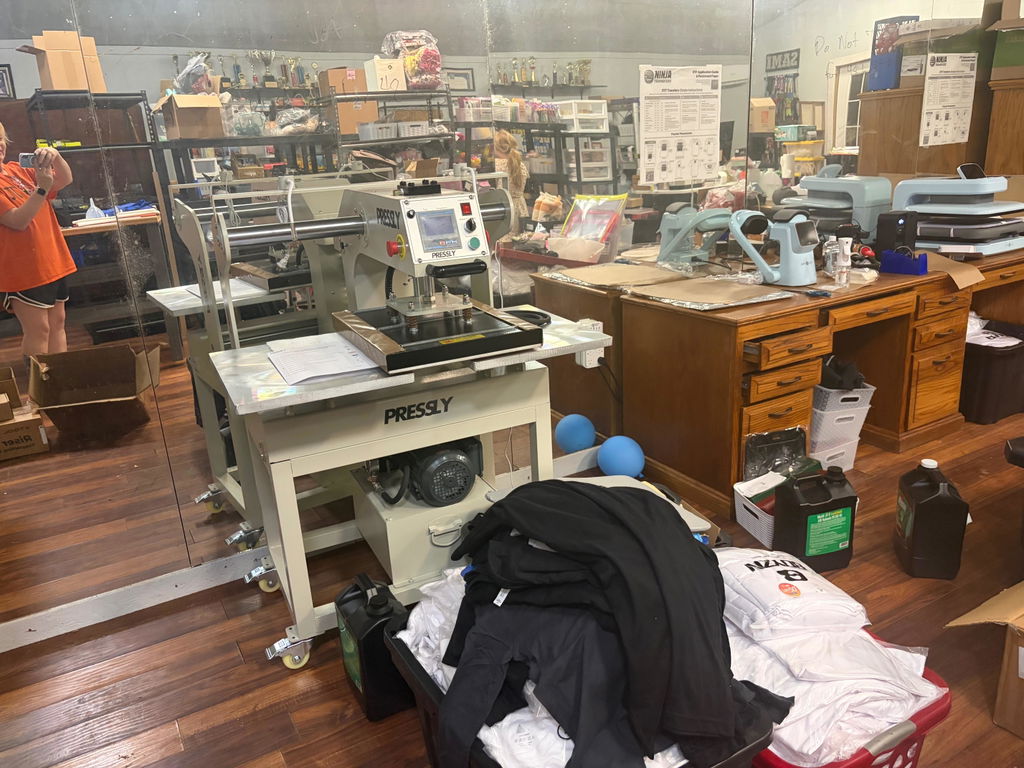
A heat press may advertise a short pressing cycle, but that number does not tell you how many finished shirts an operator can produce in an hour. The machine is only active for part of the workflow. Garments still have to be picked up, loaded, aligned, pressed, released, handled according to the transfer instructions, removed, and replaced with the next piece.
For a growing apparel shop, that distinction matters. Equipment capacity should be evaluated through the complete repeatable production cycle rather than by multiplying sixty minutes by the programmed dwell time.
This guide explains how to estimate shirts-per-hour capacity without turning a laboratory-style cycle time into an unrealistic production promise.
How Many Shirts Per Hour?
The answer depends on the complete production cycle. Measure the time from a clearly defined starting event to the same event on the next completed garment, then repeat the observation across a representative run.
Dwell time alone is not shirts-per-hour output. If a press remains closed for a certain number of seconds, that number describes only one stage of production.
Define What Counts as One Shirt
Before measuring output, define the finished unit. A shop that presses one front graphic has a different workflow from a job requiring front and back applications. A garment that requires a finishing press also contains more press activity than a one-cycle application.
The measurement should therefore identify what “complete” means for the job being evaluated.
Useful definitions may include:
- a garment after all required pressing operations are complete;
- a garment after the required carrier-removal stage;
- a garment ready to move to the next production department.
Do not mix definitions inside one comparison. If one machine is measured until the platen opens while another is measured until the garment is fully unloaded, the two output numbers describe different workflows.
Break the Cycle Into Real Actions
A practical throughput study begins by identifying every recurring action surrounding the press.
| Cycle component | What to observe | Why it matters |
|---|---|---|
| Garment pickup | How the next blank reaches the operator | Poor staging can add time to every piece |
| Loading | How the garment is positioned on the platen | Garment construction can change handling |
| Transfer alignment | How the design is positioned consistently | Precision work can take longer than simple placement |
| Press cycle | The required machine operation | This is only one part of total cycle time |
| Release and handling | What the transfer instructions require after pressing | Different materials can require different sequences |
| Unloading | How the finished garment leaves the station | Exit congestion can delay the next load |
Once these actions are visible, a production manager can identify whether the machine itself is the main constraint or whether the surrounding workflow is consuming more time.
Use a Full-Cycle Capacity Formula
Theoretical units per hour = 3,600 ÷ complete cycle seconds.
For example, if a hypothetical complete cycle takes 45 seconds from one defined starting point to the same point on the next garment, the theoretical rate is 80 units per hour.
That arithmetic is useful, but it remains theoretical. A real production hour may include garment replenishment, transfer changes, operator pauses, job transitions, quality checks, and other necessary interruptions.
Do not advertise the theoretical result as a guaranteed hourly output unless the exact test conditions and definition of a finished unit support that claim.
A stronger internal metric is a measured sustained rate over a representative batch.
Measure Sustained Production, Not One Fast Cycle
An experienced operator can often complete one carefully prepared demonstration faster than a normal working batch. That does not make the demonstration useless; it simply answers a different question.
For production planning, observe a sequence long enough to include repeated loading, normal garment handling, and the operating rhythm the shop actually expects.
If the operator pauses to restock garments, record the interruption. If artwork changes between sizes, keep that event in the production notes. If the transfer system requires a separate finishing step, include that requirement when defining completed output.
The goal is not to make the number look lower. It is to make the number useful for staffing and capacity decisions.
Separate Machine Time From Labor Time
A press can be active while the operator prepares another work position. This is one reason equipment layout can change the relationship between machine cycle time and labor time.
A dual-work-position machine, for example, may allow preparation to occur away from the active heated platen. Whether that increases completed output depends on the complete job sequence rather than station count by itself.
When comparing high production heat press equipment, ask which operator actions can occur while the machine is completing the current cycle.
Find the Actual Bottleneck
A throughput measurement becomes more valuable when it identifies what limits the next unit.
Press-Limited Production
The next garment is prepared before the machine becomes available. The operator waits for the press.
Operator-Limited Production
The press becomes available before the next garment is ready. Loading, alignment, handling, or another manual action controls the pace.
Material-Limited Production
The station waits for garments, transfers, approvals, or other inputs even though both machine and operator are available.
These constraints require different solutions. Buying a faster machine does not automatically solve a staging problem. Adding another work position does not fix a missing-transfer problem. Increasing staffing does not help if the required dwell time keeps the machine occupied.
Include Changeovers in Capacity Planning
Many real orders are not one uninterrupted run of identical shirts. Sizes change. Artwork changes. Garment styles change. The operator may need to verify the next job instruction before continuing.
Instead of hiding those transitions, track them separately.
A shop can maintain two useful measures:
- steady-state throughput for a standardized repeated job;
- mixed-job throughput for the type of order mix the business handles in normal production.
The first number helps compare process efficiency. The second is often more useful for scheduling customer work.
Avoid Common Capacity Math Errors
The most common mistake is dividing an hour by dwell time and calling the result finished shirts per hour.
Another mistake is assuming that two workstations automatically double production. If one heated head serves two preparation positions, the machine still has one active pressing cycle at a time unless the equipment documentation says otherwise.
A third mistake is mixing jobs with different requirements. A simple single-location shirt should not be used as the capacity benchmark for a complex garment requiring multiple applications.
Finally, avoid turning a short demonstration into a universal machine specification. Document the job, operator, complete-cycle definition, and batch conditions alongside the measured rate.
Use Output Data Before Buying Equipment
If the current station is producing less than expected, measure first. A short observation can reveal whether the press, operator movement, workstation layout, or job structure is creating the constraint.
Then compare new equipment against that specific limitation.
If the machine remains occupied while the operator is ready with the next garment, additional machine capacity may matter. If the machine spends significant time idle while garments are prepared, workflow changes may deserve attention before equipment replacement.
This turns a purchasing decision from “Which press is fastest?” into “Which equipment change removes our verified constraint?”
Measure Before You Scale Production
Shirts-per-hour capacity is most useful when it describes your actual process. Define the finished unit, time the complete cycle, observe a representative batch, record interruptions, and identify what controls the pace.
Once the bottleneck is clear, compare equipment using DTF Bank's high production heat press guide rather than relying on dwell time alone.
Frequently Asked Questions
Does a 15-second press make 240 shirts hourly?
Not necessarily. Dividing 3,600 seconds by 15 describes theoretical press cycles if no other time exists. Real shirt output also includes loading, alignment, release, unloading, and other required production steps.
Should breaks count in shirts-per-hour calculations?
Keep production-rate and staffing measurements clearly defined. A sustained production test should document interruptions so planners understand what the result includes.
Can two platens double heat press output?
Not automatically. Determine how many heated pressing systems operate independently and which operator actions can happen simultaneously.
What is the best throughput metric?
For shop planning, completed garments per defined production period under representative conditions is generally more useful than isolated dwell time.
Should I buy a faster press first?
Only after identifying the actual bottleneck. If the machine is not the limiting step, a faster press may not create the expected production increase.