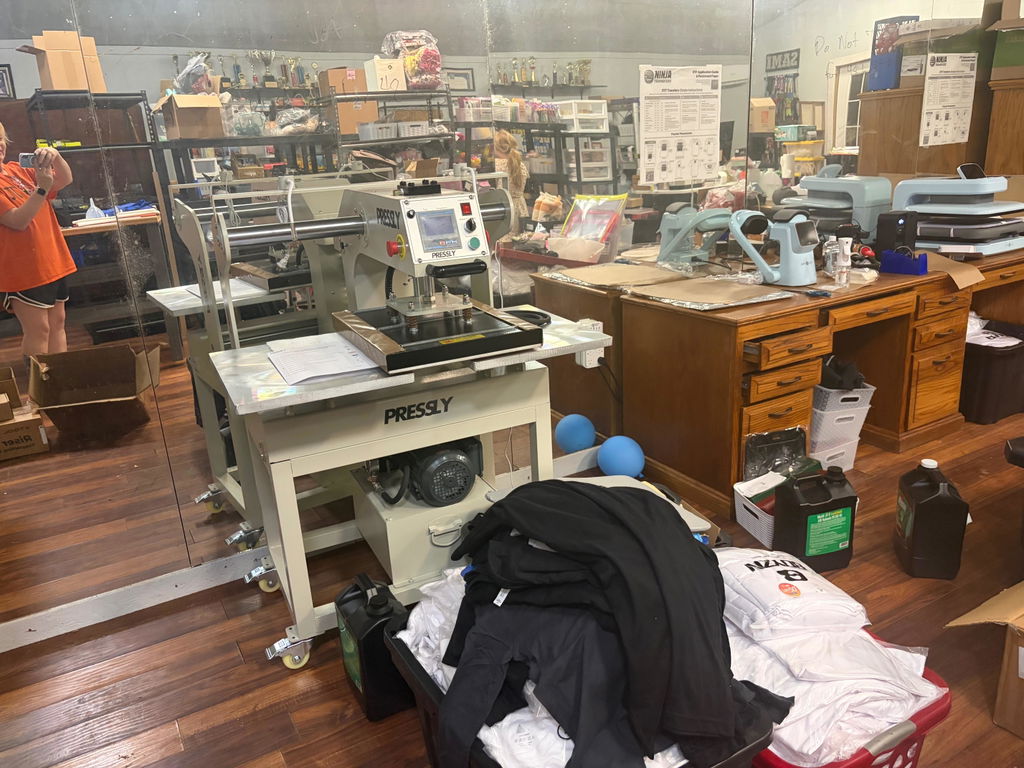
A heat press failure becomes a production problem before anyone knows exactly which component failed. Orders are already scheduled, garments may already be staged, and customers may be expecting finished work.
The first decision, however, should not be how quickly someone can get the machine moving again. The first decision is whether the equipment can remain in service safely.
After that comes production continuity: qualified service, available parts, backup equipment, order prioritization, and realistic communication with the rest of the shop.
A useful downtime plan separates those decisions instead of improvising all of them after the press stops.
Repair the Press or Use Backup?
Stop normal production when the machine shows a condition that may be unsafe or outside its documented operation. Have the problem assessed through the appropriate service path.
At the same time, evaluate whether approved work can move to another compatible press. Backup capacity is a production-continuity decision, not permission to keep operating a questionable machine.
Use a Four-Step Downtime Decision
1. Stop
Remove the affected press from normal production when required.
2. Define Impact
Identify which active orders actually depend on that machine.
3. Start Service
Use the documented technical-support and parts path.
4. Route Capacity
Move compatible work only to equipment approved for that application.
This sequence keeps safety, troubleshooting, and customer scheduling from becoming one rushed decision.
Do Not Troubleshoot Through Unsafe Operation
A machine that behaves unexpectedly should not be repeatedly cycled simply to see whether the problem disappears.
If servicing or maintenance could expose employees to unexpected startup or stored energy, OSHA's hazardous-energy standard establishes requirements for controlling that energy.
The exact service procedure depends on the equipment and workplace.
Operators should know when to stop production and whom to contact. Authorized service personnel should handle work that falls outside normal operating tasks.
Define the Production Impact First
Not every press failure stops every order.
Review the active work queue and separate jobs by the equipment they actually require.
Some garments may fit another approved press. Others may require a platen size, pressure system, working layout, or process that the available backup equipment cannot reproduce.
Do not route work based only on whether another machine becomes hot.
The backup press must be suitable for the exact transfer and garment process.
Build a Compatibility Matrix Before Failure
A simple backup matrix can save time during an outage.
| Job requirement | Main press | Backup press | Decision |
|---|---|---|---|
| Required working area | Document actual platen | Confirm usable area | Route only if application fits |
| Transfer process | Approved | Verify separately | Do not assume equivalence |
| Pressure requirement | Documented setup | Confirm capability | Do not copy gauge values blindly |
| Garment handling | Established workflow | Review platen and seams | Retest when setup changes |
The purpose is not to create a universal backup recipe. It is to know in advance which jobs can move and which must wait.
Start the Service Path Immediately
Once the affected machine is out of production, collect accurate information before contacting support.
Record the model, serial or identifying information, observed behavior, error messages, recent maintenance, and the event immediately before the problem appeared.
A description such as “the press is broken” provides little diagnostic value.
A stronger report might identify that the head stopped moving at a specific stage, the controller displayed an error, or a visible component changed condition.
Describe observations without opening protected equipment or inventing the cause.
Parts Availability Changes Downtime Risk
A failed component and an unavailable component create two separate problems.
Production-oriented equipment should therefore be evaluated partly by its support ecosystem.
DTF Bank maintains a heat press parts collection for supported PRESSLY equipment. Before relying on a machine for critical capacity, identify how compatible replacement parts and technical assistance are obtained.
Do not stock random electrical or hydraulic components simply because they look inexpensive. Compatibility must be verified for the actual machine.
And having a replacement part on the shelf does not mean an operator is qualified to install it.
Backup Capacity Must Be Real Capacity
A small secondary press does not automatically replace a larger production press.
Ask whether the backup can perform the actual jobs currently scheduled.
If the main machine uses a larger platen, a different pressure system, or a workflow that keeps the operator productive during the cycle, moving to a smaller backup may change both job compatibility and output.
That may still be acceptable. The business simply needs to schedule around the reduced capability rather than pretending capacity is unchanged.
Prioritize Orders During Reduced Capacity
When backup capacity is lower than normal capacity, the shop needs a temporary scheduling rule.
Prioritize based on confirmed deadlines, work already in process, job compatibility with the available press, and the time required to complete the remaining production.
Avoid automatically processing the easiest jobs first if that causes committed deadline work to miss its production window.
Likewise, do not promise normal turnaround while capacity is materially reduced unless the production plan supports it.
The downtime plan should help staff make consistent decisions rather than negotiating the queue garment by garment.
Measure the Cost of Single-Press Dependence
The need for backup equipment should not be decided by fear alone.
Review how much production depends on the main press, how frequently the shop operates near capacity, and what happens to customer work when that machine is unavailable.
If a press is lightly used and alternative equipment can absorb the jobs, purchasing another machine solely as backup may not be justified.
If one press controls a large share of committed production and no compatible alternative exists, redundancy may have greater operational value.
The decision is about exposure, not simply machine count.
Plan Maintenance Downtime Too
Not all downtime is unexpected.
Manufacturer-required service, inspection, and component replacement may temporarily remove equipment from production.
Schedule known maintenance against the production calendar when possible. Check which orders depend on the machine before the service date and decide whether work should be completed early or routed elsewhere.
Planned downtime gives the business a chance to test its backup plan without the pressure of a sudden failure.
Know When Backup Becomes Expansion
A second machine purchased for continuity may eventually become active production capacity.
If both presses are regularly scheduled, the business is no longer operating with one primary machine and one idle backup. It has expanded its normal capacity and should plan maintenance, staffing, workspace, and order scheduling accordingly.
This distinction matters because a backup that is constantly occupied may not be available when the other press fails.
Reevaluate the continuity plan whenever the shop's normal production pattern changes.
Include Downtime in Equipment Selection
A high-production machine should be evaluated as part of a system.
Beyond platen size and pressure capability, ask about maintenance documentation, technical support, replacement parts, installation requirements, and how the shop would handle production if the equipment became unavailable.
DTF Bank's high production heat press guide provides the broader equipment comparison. Add continuity planning to that buying decision before the press becomes the single point on which every order depends.
Plan the Outage Before It Happens
A heat press downtime plan should answer four questions before production stops: when the machine must be removed from service, who handles technical assessment, which work can move to approved backup equipment, and how reduced capacity changes the order schedule.
That preparation does not eliminate equipment failures. It prevents the first minutes of an outage from becoming the shop's first attempt at continuity planning.
Frequently Asked Questions
Should I keep using a press with an intermittent fault?
Do not assume intermittent operation is safe. Follow the machine documentation and appropriate technical or safety procedures when equipment behaves unexpectedly.
Do I need a second heat press?
Not every shop does. Evaluate how much production depends on the main press and whether compatible alternative capacity already exists.
Can any heat press serve as backup?
No. Confirm working area, transfer compatibility, pressure capability, garment handling, and the required application process before routing work.
Should I stock spare heat press parts?
Stocking verified model-specific parts can reduce procurement delay for some service events, but installation requirements and qualified service needs still apply.
What information should I send technical support?
Provide the exact model, identifying information, observed behavior, error messages, maintenance history, and the circumstances surrounding the problem without guessing at the internal cause.